ChatGPT’s New Privacy Era: What You Need to Know About Ads, Safety, and Your Company's Data
Written By: Jaclyn Misiag, NexxVia Ai Consulting
Learn how ChatGPT's New Privacy Policy Impacts Your Business!
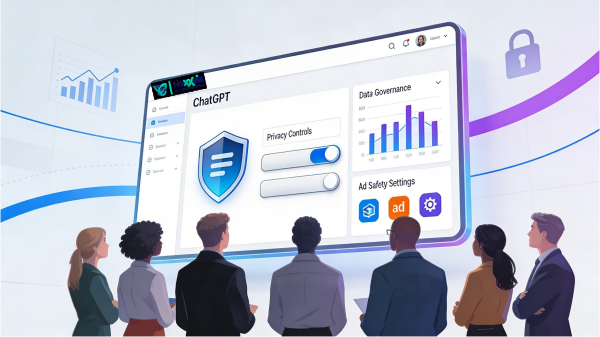
OpenAI rolled outed a set of privacy and safety updates designed to give users clearer controls over their data, advertising, and protections for teens.
Introduction:
On February 9, 2026, OpenAI rolled out a major refresh of how ChatGPT handles privacy, advertising, and safety, and it directly affects how you, your family, and your business use AI every day.
From optional contact syncing to new ad experiences on free tiers, expanded teen protections powered by age prediction, clearer retention rules over how long your data is stored, and more transparency around model training, these changes are designed to give you more transparency and to give organizations more control over data and risk. As an AI consulting partner, Nexxvia AI Consulting helps companies translate these policy updates into concrete governance, configuration, and adoption strategies.
In this post we’ll break down what’s new, what’s staying private, and the key settings you should review to keep ChatGPT aligned with your comfort level.
A Refreshed Privacy Policy: Why it Matters for Businesses
OpenAI has updated its privacy documentation to better explain:
what information is collected across its products
how that data is used
how long it is retained
which legal bases support that processing¹
The changes are meant to make it easier for the user to understand their rights, available controls, and the safeguards in place around personal data.
Why Is This Important For Businesses?
For businesses, this clarity is crucial for aligning internal AI usage with compliance obligations, especially around records management, DPIAs, and cross-border data flows.
You can review and adjust your data and privacy preferences at any time directly from your account settings, including controls over things like data use for improving models, which is particularly important for organizations handling confidential or regulated information.
Nexxvia AI Consulting works with clients to map these controls to company policies so that business units can safely leverage AI while staying within regulatory and contractual boundaries.
New Option: Find Colleagues via Contact Sync
OpenAI is introducing an optional feature that lets users sync their contacts to discover who else is using OpenAI services. This is positioned as a convenience feature for discovery, not a requirement, and you can choose whether or not to enable it at any time.
Why Is This Important For SMBs?
In a business setting, this could accelerate internal discovery of AI champions and shared workspaces, but it also raises questions about uploading professional contact lists, particularly where customers or partners are included.
Nexxvia AI generally recommends:
treating contact sync as a governed feature: define whether it’s allowed, for which groups, and under what conditions (for example, prohibiting syncing of customer contacts in high‑risk industries)
documenting this in your AI usage policy so employees understand when they can enable this option.

Ads in ChatGPT: Strategic Implications for Business Use
OpenAI is introducing ads for users on the Free and Go tiers of ChatGPT, while keeping Plus, Pro, Enterprise, Business, and Education plans ad‑free. Ads are clearly labeled as sponsored, visually separated from model responses, and are not allowed to influence the content or quality of ChatGPT’s responses.
Users will get relevant and personalized ads using information that stays only on ChatGPT, such as ads they've interacted with, or context from their chats.¹
OpenAI says advertisers do not see user conversations, chat history, memories, or personal details. Instead, advertisers only receive aggregated performance metrics such as total views, impressions, or clicks. However, ad personalization can draw on signals kept within ChatGPT, such as interaction patterns and contextual cues from chats, which users can manage or disable in settings.
Users can manage how personalized their ads are, or turn off personalization entirely, in the ChatGPT settings, including clearing ad‑related data and adjusting whether previous chats can be used to tailor ads.
OpenAI is allowing users to dismiss ads, share feedback, and get information on why a particular ad is displayed.²
From a Business Perspective, Nexxvia Sees Several Key Impacts:
This provides a new platform for businesses to market on LLM's.
For internal or sensitive work, organizations should strongly favor ad‑free tiers (Business, Enterprise, or approved Pro accounts) to minimize distraction, reduce risk, and simplify compliance narratives.
If Free or Go accounts are still in use, companies should codify where they are allowed (for example, for public research but not for proprietary data) and instruct staff to disable ad personalization when feasible.
Marketing teams may see strategic opportunities to test AI‑native ad formats, but must ensure that any campaign using ChatGPT ads aligns with your privacy notices and consent frameworks.

Teen Safety, Age Prediction, Parental Controls and Enterprise Reputation
OpenAI is expanding its use of age prediction to help determine whether an account likely belongs to someone under 18, so it can automatically apply teen‑specific safeguards across its services, including stricter content limits and additional safety filters.
For accounts identified as teens, OpenAI limits exposure to sensitive topics such as graphic violence, sexual or romantic role‑play, and content related to self‑harm, and defaults to stricter protections when age is uncertain.³

These protections are complemented by growing parental control options, including tools connected to products like Sora and Atlas that let parents:
adjust content settings
user management features such as set quiet times
receive safety‑related alerts in certain high‑risk situations with account linking¹
The overall goal is to provide age‑appropriate experiences while still allowing adults more flexibility within safety bounds.
For Businesses, This Has Two Main Implications:
If your organization builds customer‑facing experiences on top of OpenAI models, you now need to understand how teen safeguards might interact with your own content, support flows, or learning products.
Companies operating in education, gaming, or youth‑oriented sectors can leverage these built‑in protections as part of their safety narrative, but still need their own governance and logging strategy.
Nexxvia AI performs evaluations for clients on whether OpenAI’s age‑prediction safeguards sufficiently cover their regulatory exposure (for example, COPPA‑like regimes), and where additional access controls, logging, or content moderation layers are needed.
New Tools: Atlas, Sora 2, and Feature-Level Governance
OpenAI's updated privacy information also reflects newer products such as ChatGPT Atlas and Sora 2, as well as teen‑focused controls and safety mechanisms tied to those experiences. OpenAI has clarified how long different types of data are kept, which user controls apply to each product, and how those choices affect model improvement and safety systems.¹
Why Is This Important For Organizations?
These tools can expand what businesses do with AI, from multimedia content generation to advanced analytics. They also introduce new data flows, asset types, and potential exposure if not configured correctly.
Nexxvia AI Consulting recommends treating each new OpenAI capability as a separate service in your internal registry, with its own:

approved use cases
data‑classification rules
retention expectations
risk assessment
This approach helps legal, security, and business owners avoid a “one policy fits all” mindset that often fails when AI features evolve quickly.
If you use OpenAI services, it’s worth taking a moment to revisit your privacy and data settings so they match your comfort level with ads, personalization, data retention, and teen safety features in your household.
How Long OpenAI Keeps Different Types of Data
OpenAI’s privacy policy and product documentation emphasize that user data is retained only as long as needed to provide services, prevent abuse, comply with law, or improve system reliability, with specific windows for certain products.
For example, for many services, OpenAI retains logs and response objects for around 30 days by default to support abuse monitoring and reliability
While some newer agent‑style tools keep deleted interaction data for up to 90 days to analyze potential misuse and strengthen safeguards.
From a Business Perspective, Here's The Impact:
Enterprise and business offerings, as well as API usage, often have more stringent controls:
By default, API data is not used to train models unless customers explicitly opt in
Retention policies can be tailored via contracts, privacy portals, or platform settings
These distinctions are critical for organizations that must align OpenAI usage with internal retention schedules or industry‑specific record‑keeping rules
Nexxvia AI performs the following for clients:
Inventory which OpenAI products are in use and map each one’s retention window to internal policies.
Decide when to rely on OpenAI’s default retention versus when to implement additional anonymization, tokenization, or data‑minimization layers before sending data.
Document retention behavior in internal AI playbooks so compliance and audit teams have a clear, current picture.
How Data and Choices Affect Model Improvement and Safety Systems
OpenAI uses a subset of user interaction data to improve model performance, understand user needs, and strengthen safety systems, while applying various techniques to reduce personal information in training datasets. Users and organizations can typically control whether their content is used for training through settings such as “Improve the model for everyone” or via dedicated privacy portals and enterprise agreements.
From a Business Standpoint, Opting In or Out is a Strategic Choice:
Opting out can reduce confidentiality risk and simplify legal review, which is why many enterprise and business plans default to not training on customer data unless explicitly requested.
Opting in may help OpenAI’s models perform better on the kinds of tasks your users run most often, but may require a clearer explanation in your privacy notices and internal approvals.

On the safety side, retaining limited interaction data for a defined period allows OpenAI to detect abuse, fraud, and policy violations more effectively, which ultimately benefits organizations that rely on ChatGPT for customer support, content generation, or internal copilots.
Nexxvia works with clients to decide where it is acceptable—and beneficial—to share more signals for safety and model improvement, and where strict isolation is needed due to trade secrets, regulated data, or high‑stakes decision‑making.
Turn OpenAI's Privacy Shift into Your Advantage

If your organization is using ChatGPT or planning broader OpenAI adoption, these privacy and safety updates are not just legal fine print—they directly shape your risk posture, governance model, and ROI from AI. Nexxvia specializes in turning evolving AI policies into concrete guardrails, configuration playbooks, and change‑management plans, so your teams can move fast without losing control of your data.
If your organization is navigating these new OpenAI privacy, ads, and safety changes and you’re not sure how to adapt your policies or workflows, this is the moment to get expert help.
👉 Schedule a call with Nexxvia AI Consulting to:
Audit how your teams are currently using ChatGPT and other OpenAI tools.
Design practical guardrails for privacy, data retention, and model‑improvement settings.
Stand up secure, business‑ready AI workflows that align with your compliance and risk requirements.
Contact Nexxvia AI today to schedule a consultation and turn these policy changes into a clear, actionable AI strategy for your business.
Sources:
Open AI, "US Privacy Policy," February 9, 2026, https://openai.com/policies/us-privacy-policy/.
Juli Clover, "ChatGPT Now Has Ads for Free and Go Tier Users," Macrumors, February 9 2026, https://www.macrumors.com/2026/02/09/chatgpt-now-has-ads/.
Rawat, Abhijay Singh, "OpenAI to Predict 'Every' User's Age to Ensure Teen Safety Using ChatGPT." Times of AI, January 21, 2026, https://www.timesofai.com/news/openai-chatgpt-age-prediction/.
Disclosures:
This article is intended to provide you with general information regarding AI regulations and content. The contents of this article are not intended to provide specific legal advice. If you have any questions about the contents of this document or if you need legal advice as to an issue, please contact a licensed attorney in your state. This communication may be considered advertising in some jurisdictions. The information in this article is accurate as of the publication date. Because the law in this area is changing rapidly, and insights are not automatically updated, continued accuracy cannot be guaranteed.


