Why Small Businesses that Adopt AI in 2025 Are Growing Faster- Not Cutting Jobs: EY & Open AI Insights

Written By: Jaclyn Misiag, NexxVia Ai Consulting
December 8, 2025- December 9, 2025
Released last week, these two new 2025 reports from Ernst & Young (EY) and OpenAI show AI boosts productivity without layoffs. Learn why small businesses are reinvesting in growth—and how expert AI consulting accelerates results.
Businesses that implement AI strategically are growing faster -not replacing their people.
Introduction:
2025 marked a pivotal year in business adoption of artificial intelligence — where the focus has shifted from fear of automation to measurable productivity gains and strategic reinvestment.
Two influential industry reports released last week, EY’s US AI Pulse Survey (December 9, 2025) and OpenAI’s “State of Enterprise AI 2025” report (December 8, 2025), reveal that AI is reshaping how organizations operate, upskill, and structure their future workforce. This blog post synthesizes key insights from both, grounded in verified data and trending business practice.
Insight #1: AI Productivity Gains Drive Reinvestment Over Job Cuts
We have learned through our consulting that one of the biggest fears among small business owners is that AI adoption automatically leads to layoffs or cultural disruption.
One of the most striking findings from the EY US AI Pulse Survey is that productivity gains from AI are not primarily leading to workforce reductions.
According to EY’s 2025 AI Pulse Survey, most organizations experiencing AI productivity gains are:
Reinvesting these benefits into AI capabilities (both existing and new platforms), research and development, and cybersecurity.
Expanding customer experience initiatives
Funding employee training and reskilling, instead of cutting jobs¹
Only ~17% of organizations reported reducing headcount as a result of AI-driven productivity, overturning the common narrative that AI chiefly serves as a labor replacement tool.¹

What this means for small businesses:
AI works best as a force multiplier for small teams, not a replacement. It allows lean companies to compete with much larger players.
Insight #2: Workforce and Skills Development Are Top Priorities
Beyond reinvestment, EY’s research underscores the importance of reskilling and upskilling to harness AI’s full potential.
Firms are prioritizing training initiatives and talent development as AI becomes embedded in workflows. ¹
Recent related surveys show that organizations risk losing significant productivity gains — as much as 40% — if workers lack the skills or readiness to leverage AI effectively. ¹
This highlights a paradox: broad AI tool adoption does not automatically translate into maximal productivity without the right human support systems in place.
AI strategy must include robust talent and education frameworks, not just technology adoption.

Insight #3: AI Saves Time Immediately—Even Before Full Automation
The OpenAI “State of Enterprise AI 2025” report analyzed usage from over 1 million business customers and surveyed 9,000 workers across 100+ companies. Their recent report provided complementary insights on how organizations experience AI on a day-to-day basis.²
Key findings highly relevant to small businesses:
75% of workers say AI improves the speed or quality of their work²
Average time saved: 40–60 minutes per day per employee²
For a 10-person business, that’s the equivalent of adding more than one full-time employee — without hiring.

Why small businesses benefit faster:
SMBs have fewer layers of approval, fewer legacy systems, and can implement AI workflows much faster than enterprises.
This underscores a broader industry shift: AI is now embedded into workflows as a productivity multiplier — not simply as a novelty or pilot project.
Insights #4: The Biggest Gains Come from Strategy, Not Tools
Both reports emphasize a critical point:
The companies seeing the biggest gains are not “using AI more,” they are using it more intentionally.
High-performing organizations:
Embed AI directly into daily workflows
Standardize repeatable tasks
Align leadership around clear AI goals
Invest in change management and training
Small businesses often struggle here — not due to lack of motivation, but lack of clear AI strategy and implementation guidance.

Adoption Trends and Strategic Priorities
Both reports reveal how AI adoption varies across industries and how enterprises are prioritizing their AI efforts:
📌 Broad adoption
OpenAI’s analysis shows that AI tools are moving past the Proof-of-Concept phase into mission-critical infrastructure, with companies embedding AI into core business workflows. ³
📌 Sector momentum
Reports indicate that technology, healthcare, and manufacturing sectors are among those seeing rapid AI adoption and momentum, with measurable business value accruing across functions. ⁴
📌 Role of advanced tools
Firms investing more substantially in AI (e.g., $10M+ across teams) report higher productivity gains — suggesting that scale and strategic commitment matter.⁵
Why Most Small Businesses Stall At This Stage
Many small business owners know AI could help them, but hesitate because it feels risky, complex, or “too enterprise-level.”
That hesitation is understandable. But new 2025 data from EY and OpenAI shows a clear pattern:
Businesses that implement AI strategically are growing faster -not replacing their people.
The real risk in 2025 isn't adopting AI incorrectly. The risk is not adapting it at all while competitors quietly do.
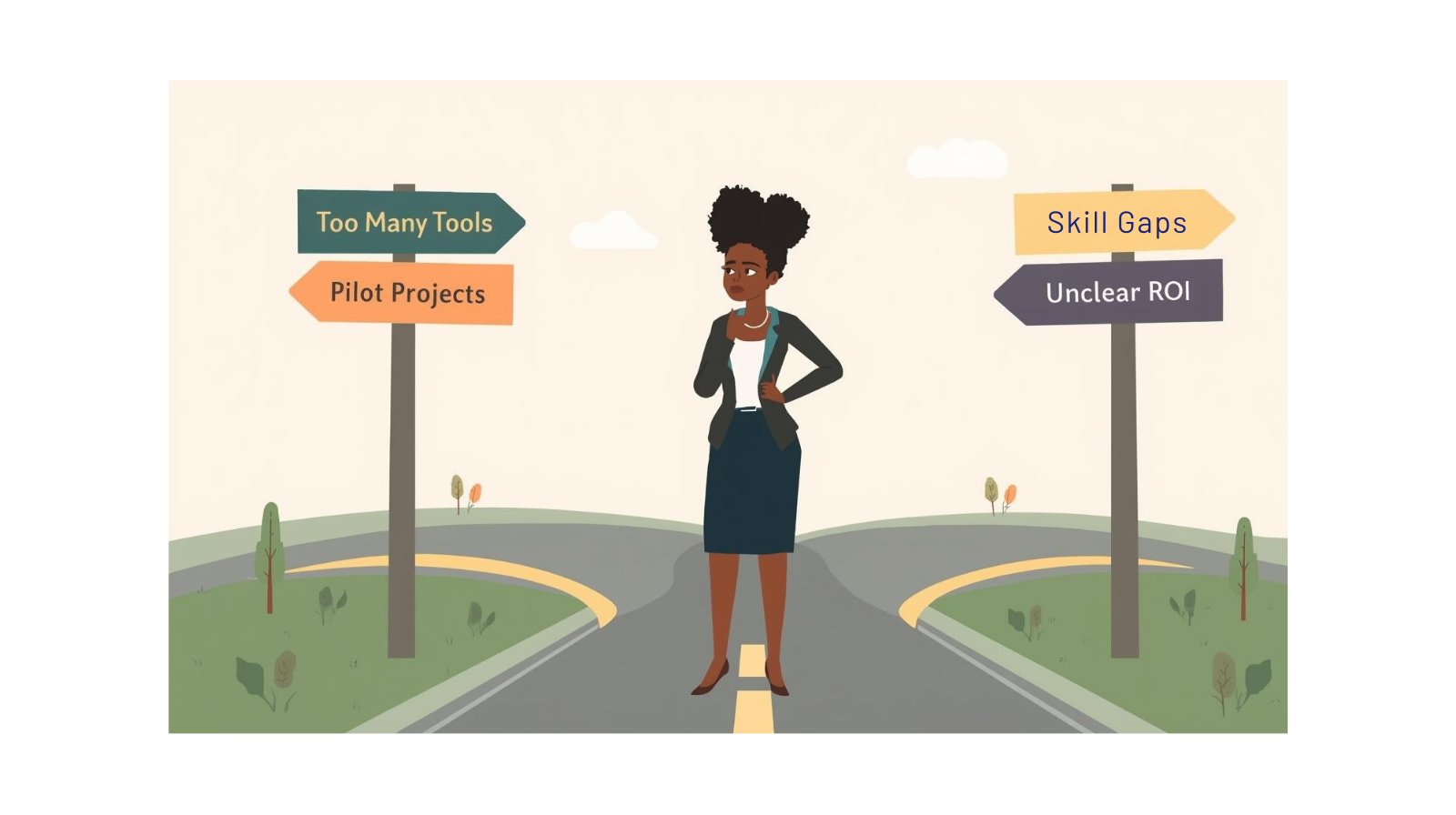
From our consulting experience, most SMBs get stuck in one of three places:
Tool overload—too many AI tools, no clear ROI

Pilot paralysis—Experiments that never scale
Skill gaps—Teams unsure how to use AI beyond basic prompts
This is exactly where expert AI consulting makes the difference.
Balancing Optimism with Practical Workforce Considerations
While the overall story is positive, both reports highlight areas needing executive focus:
Skill gaps remain a barrier: EY’s research suggests that despite high levels of tool adoption, advanced use and transformational impact remain limited unless employees develop deeper capabilities. ¹
Human-AI collaboration needs governance: As organizations integrate AI more deeply, they must balance technology deployment with clear policies, ethics, and talent development strategies.
Featured Resource: AI-Bound: The Change Management Workbook
Accelerate Your AI Adoption With People-First Change Management
Transforming your business with AI isn’t just about tools — it’s about people, processes, and momentum. That’s exactly what AI-Bound: The Change Management Workbook delivers.
👉 This practical guide walks you through every stage of change management — from readiness assessment to sustainable adoption — so you can lead your team confidently through AI transformation. It’s designed for small and mid-size business leaders who want to implement AI strategically, minimizing disruption and maximizing value.

Highlights you’ll find inside:
A step-by-step change management framework tailored to AI initiatives
Practical worksheets and exercises to diagnose readiness and align teams
Tools for managing resistance, embedding new workflows, and driving adoption
Expert guidance that keeps people engaged throughout transformation
Whether you’re just starting with AI or ready to scale your use cases, AI-Bound gives you the playbook to turn strategy into lasting results — with your team on board.
Get your copy today for only $39.99: https://aibound.nexxvia.com/offer
How Strategic AI Consulting Accelerates Small Business Results
Unlike enterprises, small businesses don’t need massive AI platforms. SMBs need focused, outcome-driven implementation.

A proven AI consulting approach typically includes:
Identifying high-ROI workflows (sales, marketing, operations, customer support)
Selecting the right AI stack (not the most tools)
Implementing AI directly into existing systems
Training teams for real-world use (not theory)
Establishing governance so AI remains safe and scalable
This approach removes guesswork and accelerates results.
Conclusion: What This Means for You as a Small Business Owner
The 2025 landscape of AI in enterprise is not defined by job losses or simple automation hype, but by productivity enhancements, strategic reinvestment, and human-centered transformation.
The takeaway from both EY and OpenAI is clear:
AI adoption is no longer experimental
Productivity gains are real and measurable
Growth comes from strategy + execution, not curiosity alone
Small businesses that act now gain:
Faster operations
Stronger customer experiences
More capacity without more headcount
A defensible competitive edge
Key insights for leaders:
Use AI to reinvest in innovation, not just cut costs.
Prioritize workforce training and readiness to unlock full productivity gains.
Leverage data-driven adoption patterns to benchmark AI success across industries.
Those that wait will face competitors who quietly operate faster, leaner, and smarter. Combining the EY Pulse Survey and OpenAI’s enterprise report creates a data-backed narrative: AI is elevating work, not replacing it, and organizations that align strategy, skills, and investment will lead in the next wave of digital transformation.
Next Step: Turn AI Curiosity into Business Impact
If you’re interested in AI but unsure where to start, the solution isn’t another tool — it’s a clear strategy and expert implementation.
👉 This is where our consulting team comes in.
We help small businesses design, implement, and scale AI systems that actually move the needle — safely, efficiently, and profitably.
AI doesn’t replace your business.
It amplifies it — when done right.
If you need help navigating these changes or developing a clear AI strategy for your business, Nexxvia AI Consulting can provide support.
Sources:
EY Americas, "EY Survey: AI-driven productivity is fueling reinvestments over workforce reductions"," EY, December 9, 2025, https://www.ey.com/en_us/newsroom/2025/12/ai-driven-productivity-is-fueling-reinvestment-over-workforce-reductions.
Open AI, "The state of enterprise AI," December 8, 2025, https://openai.com/index/the-state-of-enterprise-ai-2025-report/.
PYMNTS, "OpenAI Report Shows Soaring Enterprise AI Adoption," December 9, 2025, https://www.pymnts.com/artificial-intelligence-2/2025/openai-ai-business-adoption-soars-as-employees-save-over-an-hour-daily/.
Bakolia, Ravikash, "OpenAI says enterprise AI gaining momentum in tech, healthcare, manufacturing," Seeking Alpha, December 8, 2025, https://seekingalpha.com/news/4529291-openais-report-shows-enterprise-ai-gaining-momentum-in-tech-healthcare-and-manufacturing?utm_source=chatgpt.com.
Faridi, Omar, "AI Driven Productivity Is Fueling Reinvestment over Workforce Reductions: EY," Crowd-Fund Insider, December 10, 2025, https://www.crowdfundinsider.com/2025/12/256326-ai-driven-productivity-is-fueling-reinvestment-over-workforce-reductions-ey/?utm_source=chatgpt.com
Disclosure:
This article is intended to provide you with general information regarding AI news. The contents of this article are not intended to provide specific legal advice nor financial advice. If you have any questions about the contents of this document or if you need legal advice as to an issue, please contact a licensed attorney in your state. This communication may be considered advertising in some jurisdictions. The information in this article is accurate as of the publication date. Because the law in this area is changing rapidly, and insights are not automatically updated, continued accuracy cannot be guaranteed.


