Does Your Business Really Need an AI Agent?
Written By: Jackie Misiag, NexxVia Ai Consulting
Content and images are AI-assisted, with human editing and oversight. This blog post and its visual elements were drafted using artificial intelligence tools. The final piece has been thoroughly reviewed, fact-checked, edited, and manually published by a human author to ensure accuracy and quality.
Does your business really need an AI agent? The answer depends on far more than the newest platform or the most impressive demonstration. It depends on the work, the people responsible for it, the information involved, the business outcome you expect, and the level of responsibility you are prepared to give AI.
A practical guide to choosing the right level of AI automation based on the work your team performs the risk involved and the business value you expect
Introduction: The AI Decision Hiding Inside Your Business
AI agents have quickly become one of the most talked-about ideas in business technology. Owners and leadership teams are hearing promises of software that can plan work, use tools, make decisions, and complete tasks with less human direction. The possibilities are exciting, especially for companies facing rising costs, limited staffing, slow follow-up, and too much manual work.
The excitement also creates a difficult question: does your business really need an AI agent? An agent is only one option. In many companies, the faster and safer win is an AI assistant or a well-designed AI workflow. Choosing correctly can:
improve productivity
reduce operational friction
create measurable return on investment.
Choosing poorly can add cost, complexity, and risk without solving the original problem.
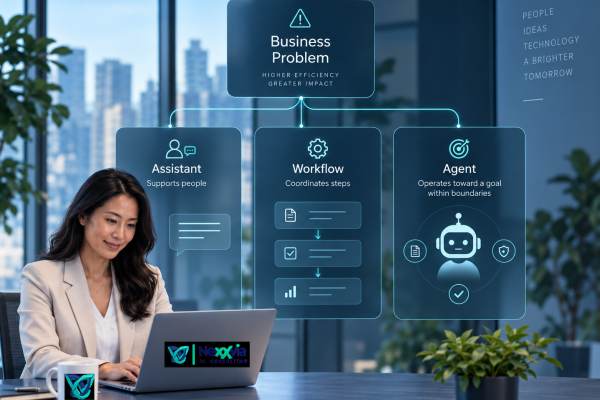
The decision becomes clearer when you examine three things:
how predictable the work is
how much judgment it requires
how much authority the technology should have
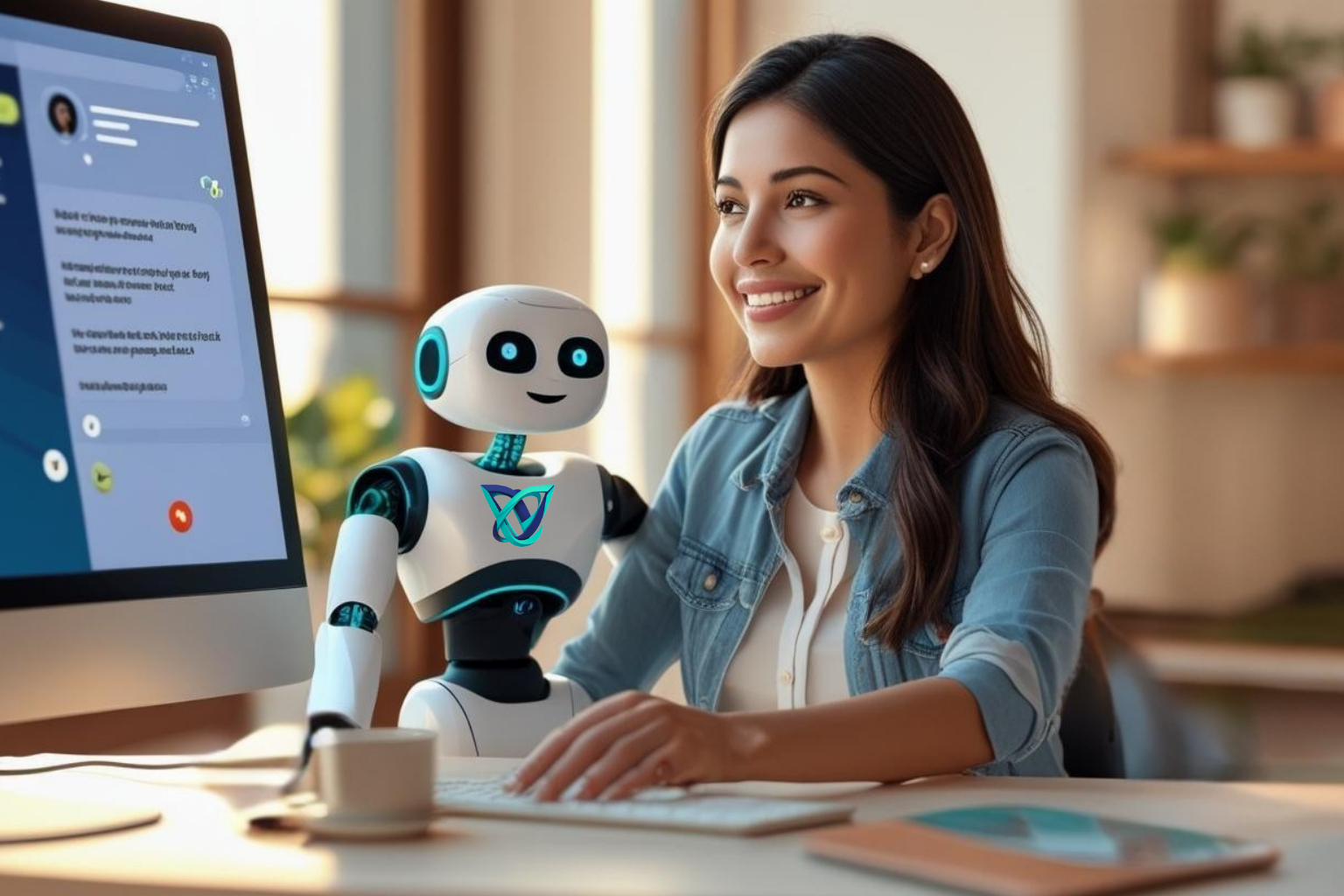
Chatbots can function as the front-end format for either an AI assistant or an AI agent.
Nexxvia AI Consulting is hosting a free live webinar on September 29, 2026. Business owners have been asking us where AI assistants, workflow automation, and AI agents actually fit in their business. The language is often used interchangeably, even though the business implications are very different. Reserve your free seat and join the conversation.
What is an AI Assistant?
Let's slow down and start with the basics. What do these terms actually mean?
An AI Assistant supports a person while that person remains in control.
An AI assistant generally works with a person. Someone asks a question, provides direction, reviews the response, and decides what to do next. Generative AI tools can support writing, research, analysis, planning, and other knowledge work while the employee remains responsible for the outcome.
How can small businesses use AI Assistants?
The employee initiates the task, reviews the output, and decides what happens next. Think of tools such as ChatGPT or Microsoft Copilot used for individual knowledge work. An assistant is a strong fit when the work benefits from generative AI but still needs context, judgment, tone, or approval.
The value comes from faster thinking and execution, not from removing people from the process. For many small and midsize businesses, an AI assistant is the most practical starting point for AI adoption because it delivers near-term value with limited system access and a clear human-in-the-loop.
What is an AI Workflow?
An AI Workflow moves work through a defined process.
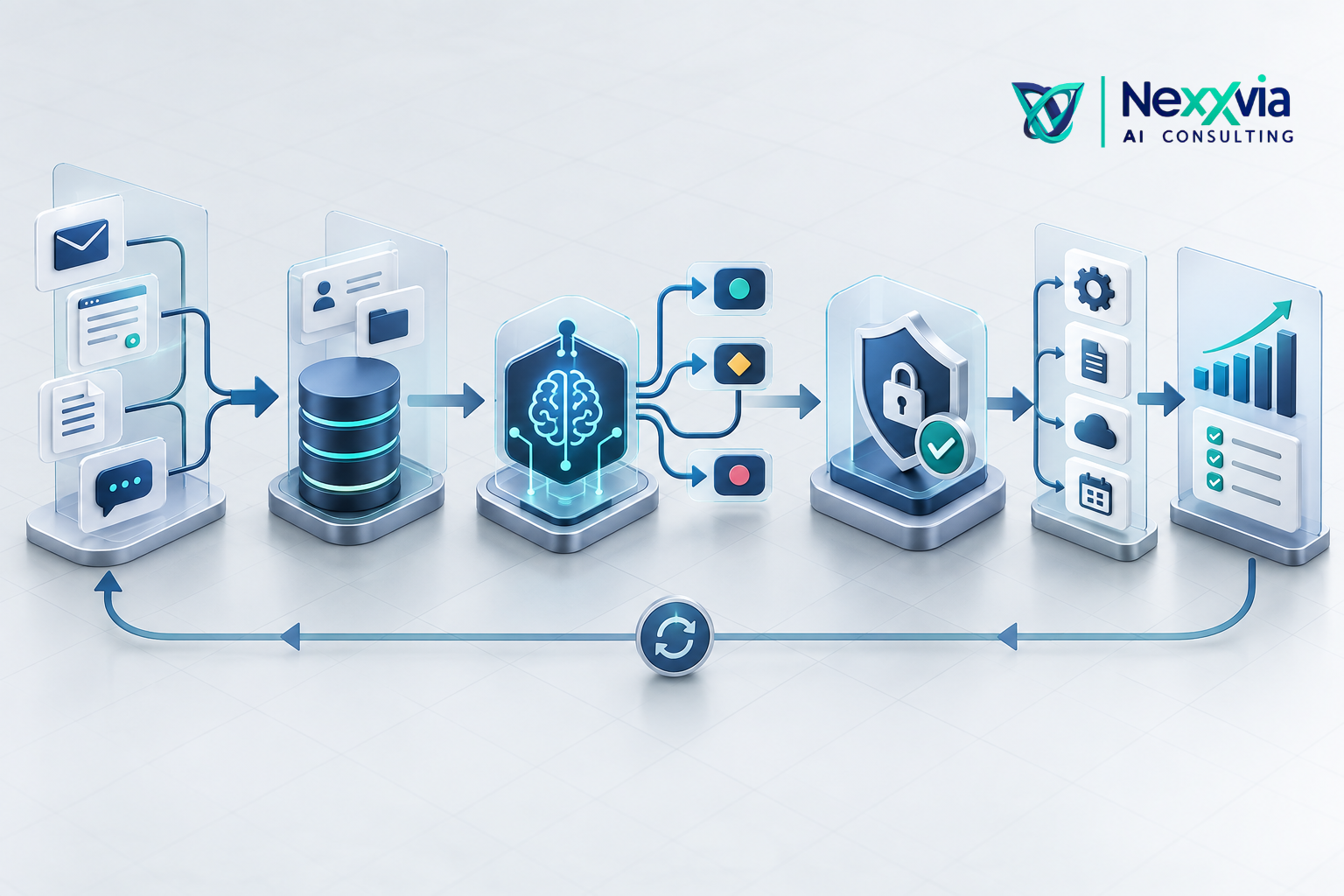
A trigger starts the workflow, information passes between systems, and established rules determine what happens. AI can contribute to individual steps, such as summarizing a request, classifying an inquiry, extracting information from a document, generating a draft, or scoring an opportunity, but the overall process remains structured and predictable.
Microsoft describes modern business process automation as "connecting apps, systems, and websites while adding security, governance, monitoring, and process optimization." ²
Consider an inbound lead. A workflow can capture the form, create the contact record, assign the owner, send an acknowledgment, schedule follow-up, and alert a manager when the lead is untouched. AI might summarize the request or recommend a response, while business rules control routing and timing. The process is repeatable, measurable, and easier to audit.
AI workflow automation is often the best answer when a company wants consistency, speed, and fewer handoff failures.
How can businesses utilize AI workflows?
AI workflows are great for onboarding, invoice processing, appointment reminders, document intake, customer service triage, and approval processes. Because the path is defined, organizations can test exceptions, assign ownership, monitor performance, and calculate ROI more reliably.
What is an AI Agent?
AI Agents can receive a goal, determine the steps required, select tools, take action, review results and adjust its approach based on what it encounters.
IBM defines an AI agent as a system that autonomously performs tasks by designing workflows with available tools.³ Agents can interact with databases, APIs, software applications, websites, and other agents.
That flexibility makes agentic AI useful for open-ended work where the path cannot be fully mapped in advance. It can plan and act across multiple steps instead of waiting for a new prompt at each stage.
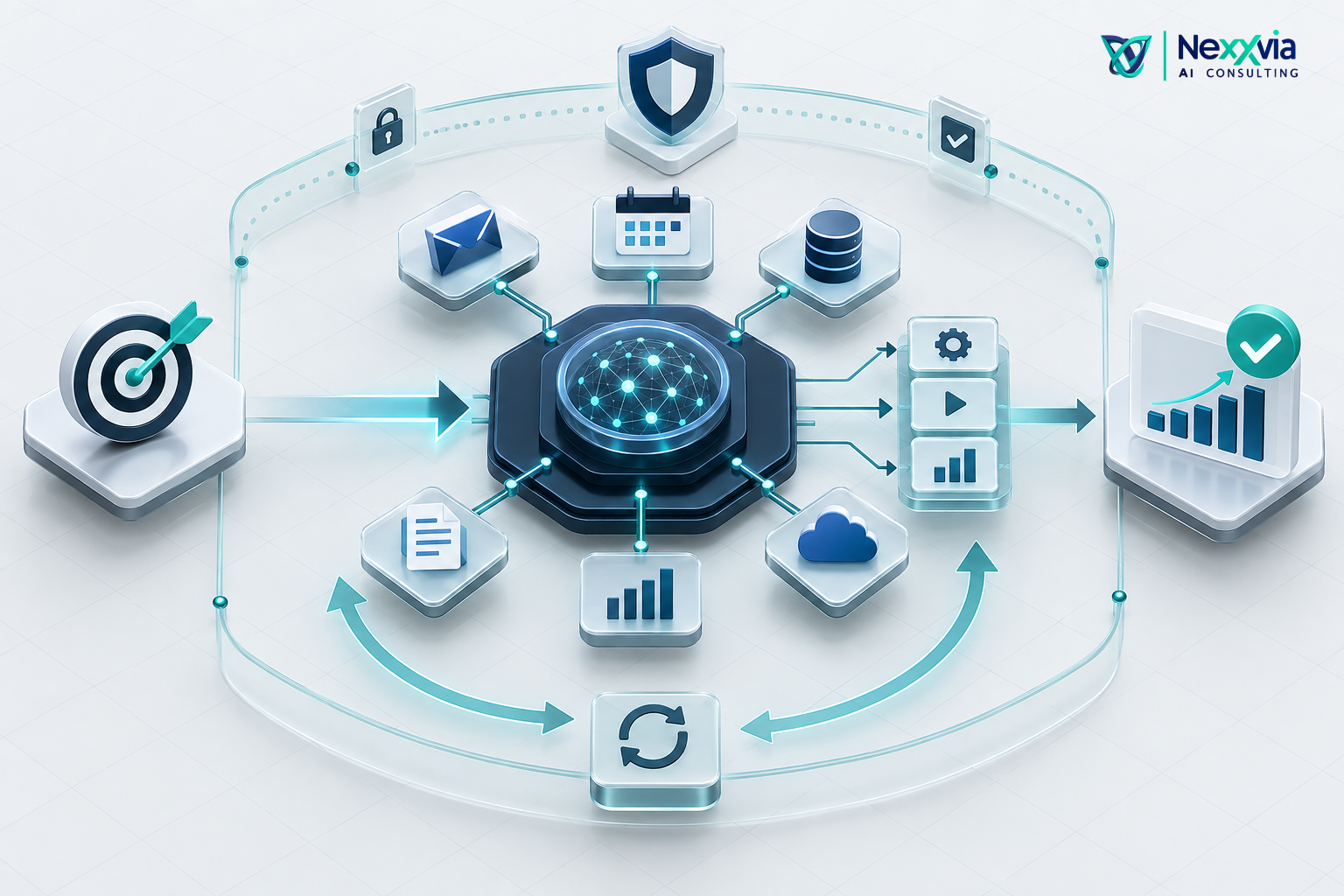
Greater autonomy also creates greater exposure. An agent with access to customer data, email, financial systems, or external communications can make mistakes at scale. Strong AI governance, identity and access controls, logging, testing, escalation rules, and human approval checkpoints become essential. Anthropic notes that agents can carry higher costs and compounding errors, making sandbox testing and guardrails important.¹
That short comparison explains the labels, but it does not answer the business decision.
An AI Assistant can be highly valuable without controlling a process.
A Workflow can transform productivity without making independent decisions.
An AI Agent can introduce flexibility, but also requires more trust, testing, access, and oversight.
Anthropic describes workflows as "systems that follow predefined code paths", while "agents dynamically direct their own processes and tool use".¹
The Technology is Only Part of the Decision
Customer Service is swallowing the day with customers wanting answers now.
Let's look at this example. Imagine two businesses experiencing the same symptom: inbound leads are not receiving timely follow-up. One business may have a training issue while the other may have an unclear process, incomplete CRM data, conflicting ownership, or no standard for what timely follow-up means. Adding AI before identifying the breakdown can automate confusion and make the problem harder to see.
From our experience, this is where many AI initiatives lose momentum. Most leaders begin with a product and work backward, trying to find a place to use it. Employees are asked to adopt technology without understanding how their roles will change. Data is scattered. Exceptions were never documented. Nobody owns the outcome. A promising demonstration becomes another disconnected tool.
The more responsibility AI receives, the more these gaps matter. Agentic AI may need access to customer records, calendars, email, documents, financial information, or external systems. Every additional connection creates questions about authority, privacy, accuracy, cybersecurity, accountability, and human approval. The National Institute of Standards and Technology (NIST) AI Risk Management Framework encourages organizations to incorporate trustworthiness into the design, development, use, and evaluation of AI systems.⁴
Questions Worth Asking BEFORE You Invest in AI
Business owners and Executives do not need another technical lecture. They need a practical way to examine the business.
Where could AI strengthen productivity and improve a measurable result?
Which repetitive processes deserve attention first?
When is an assistant enough?
When does structured automation make more sense?
When might an AI agent be appropriate?
And when should the answer be no AI at all?
Those questions lead to a better conversation about value. Saving a few minutes is useful, but the larger opportunity may be improving follow-up, reducing delays, strengthening decision quality, protecting customer experience, or giving employees better access to reliable information. The right opportunity should connect operational friction to a result leadership already cares about.
Readiness matters just as much as opportunity. Processes need to be understood. Information must be accurate and accessible. Employees need to know where human judgment remains essential. Safeguards, ownership, monitoring, and escalation paths must be clear before AI receives more responsibility. These are business design decisions, not simply technology settings.
A FREE Webinar You Do Not Want to Miss
What we will examine in our webinar
During the 45-minute session, we will give business owners and senior leaders a clearer way to think about assistants, workflows, and agents. We will examine:
where each approach may fit in your business
what needs to be in place before increasing autonomy
how to identify one practical opportunity without trying to transform the entire company at once
You will also see why business readiness, employee involvement, clear ownership, and responsible AI governance matter before any organization moves from experimentation toward implementation at scale with confidence and measurable accountability internally.
The session is designed for leaders who know AI can create value but are unsure where to begin, what to implement, or how to move forward responsibly. It is also relevant for companies already experimenting with generative AI but struggling to connect those experiments to consistent business performance.
You will leave with:
better questions
a clearer view of the choices in front of you
a practical next step to examine inside your organization.
We will not assume that every business needs an AI agent. The objective is to determine what level of AI, automation, and human oversight makes sense for the opportunity you are considering.
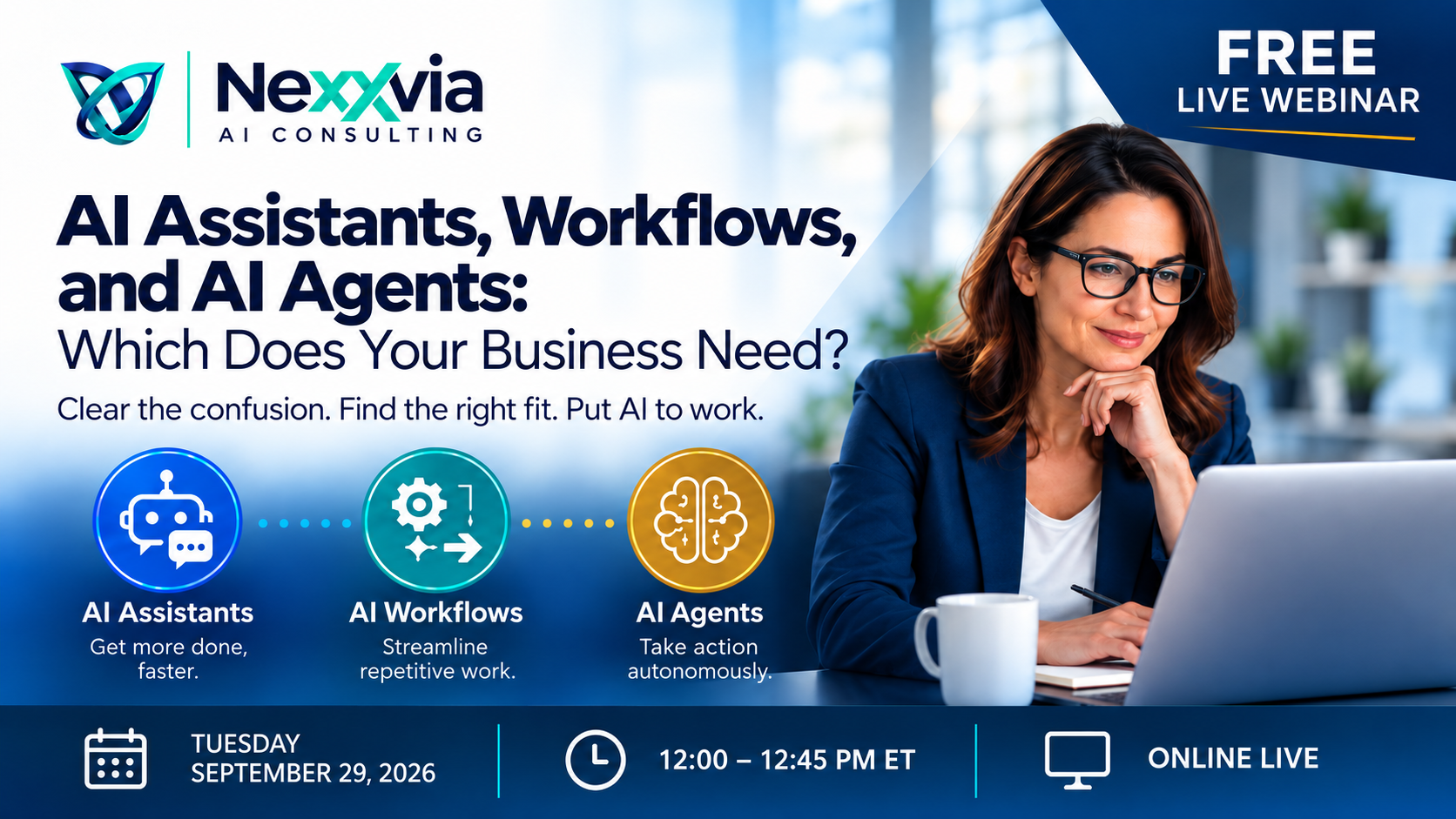
Join Nexxvia AI for the FREE Live Webinar
AI Assistants Workflows and AI Agents Which Does Your Business Need will be held Tuesday, September 29, 2026, from 12:00 to 12:45 p.m. ET. The online session is free, but registration is required.
If AI is on your business agenda, this conversation can give you a more grounded way to decide what deserves attention first. Register free for the webinar. You can also explore Nexxvia's AI consulting services and learn more about our consulting team.
Why Businesses Hire Nexxvia AI Consulting
Many businesses are using AI, but very few are deploying it well.
Most small business owners do not need another list of AI tools. They need someone who can look at the bottlenecks, identify the highest-value opportunities, and implement systems that produce immediate operational lift.
That is why businesses hire Nexxvia AI Consulting. Nexxvia implements practical AI and automation systems for marketing, lead follow-up, CRM workflows, customer communication, reporting, scheduling, and operations. The work is hands-on, action-oriented, and designed to create speed, clarity, and measurable results without unnecessary complexity.
👉 Schedule a call with Nexxvia AI Consulting
Just as important, the implementation model stays accessible. In a market where budget discipline matters, Nexxvia delivers surprisingly cost-effective execution compared with the ongoing cost of manual labor, missed follow-up, delayed response times, and fragmented operations.
Sources:
1. Anthropic. "Building Effective Agents." December 19, 2024. https://www.anthropic.com/engineering/building-effective-agents.
2. Microsoft. "Power Automate: Business Process Workflow Automation." Accessed September 21, 2026. https://www.microsoft.com/en/power-platform/products/power-automate.
3. Gutowska, Anna. "What Are AI Agents?" IBM. Accessed September 21, 2026. https://www.ibm.com/think/topics/ai-agents.
4. National Institute of Standards and Technology. "AI Risk Management Framework." Accessed September 21, 2026. https://www.nist.gov/itl/ai-risk-management-framework.
Disclosures:
This article is intended to provide you with general information regarding AI and content. The contents of this article are not intended to provide specific legal or financial advice. If you have any questions about the contents of this document or if you need legal or financial advice as to an issue, please contact a licensed attorney or CPA in your state. This communication may be considered advertising in some jurisdictions. The information in this article is accurate as of the publication date. Because the law in this area is changing rapidly, and insights are not automatically updated, continued accuracy cannot be guaranteed. Content and images are AI assisted, with human editing and oversight.


